Skip to content Skip to sidebar Skip to footer

A Journey Through Cancer: Treatment, Healing, and Hidden Struggles(Part II)
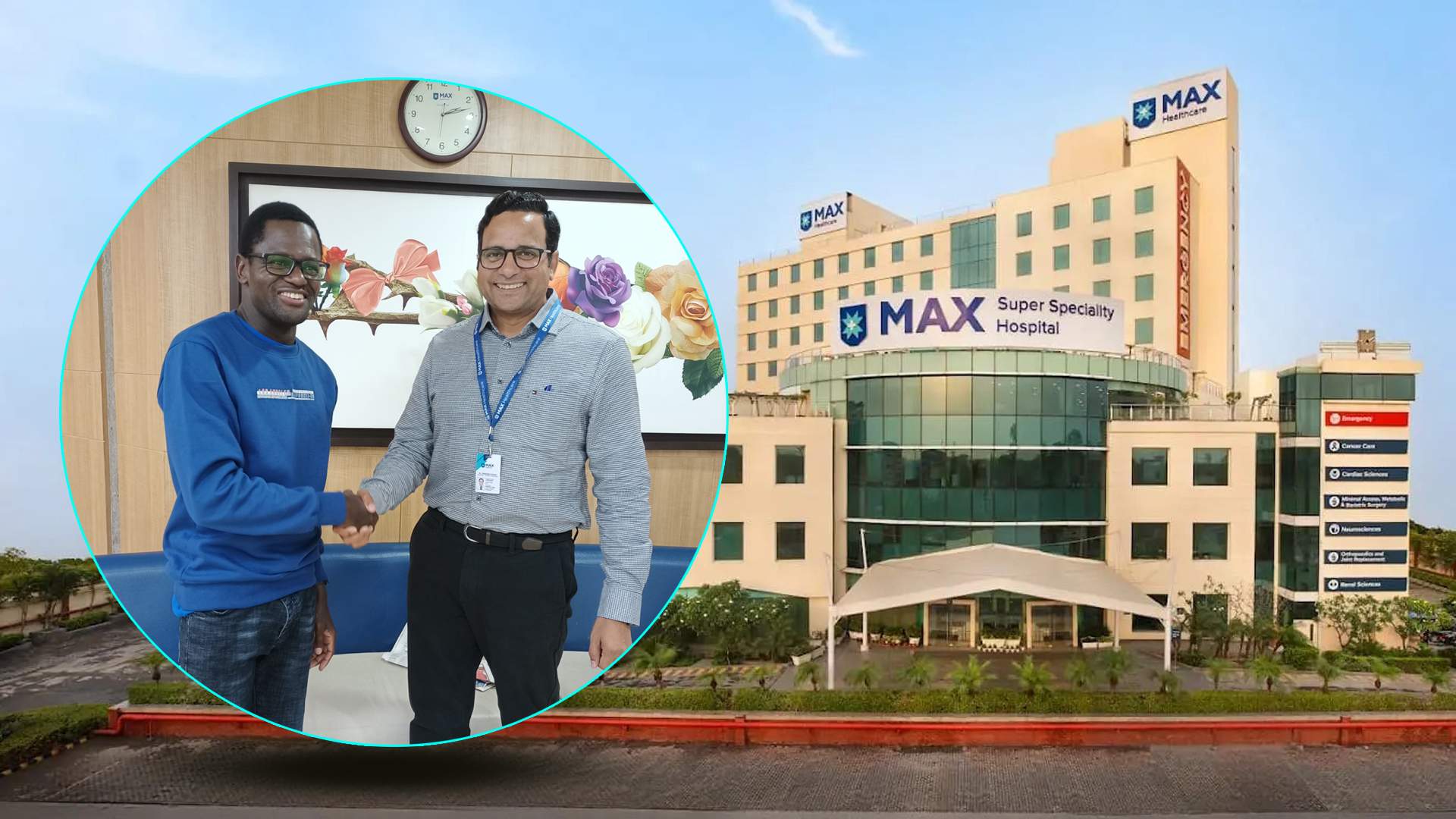
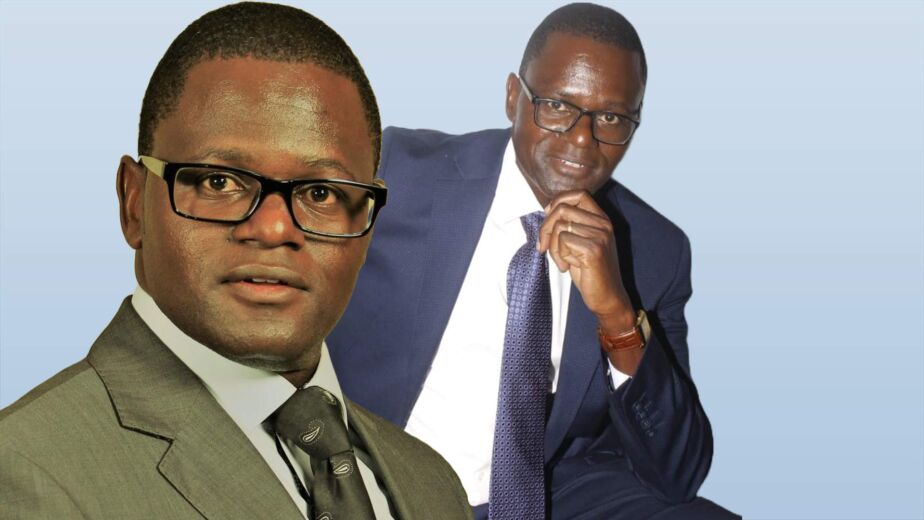
Dr. Rajender Kumar (Right), HOD of Radiology, and his patient Kizito Namulanda (Left), outside MAX Super Specialty Hospital. Photo in-set shows them inside the hospital lobby.

Editor’s Introduction
Dear valued readers,

Life, like a winding river, rarely travels in a straight line. It twists, turns, and flows forward—even through challenges. When obstacles arise, we remember that life goes on, and we can choose to keep flowing, even when the current is strong. Challenges can slow us, ground us, or bury us, yet they can also make us stronger and more prepared for what lies ahead.

At Kollea Hub, we transform challenges into inspiration through powerful storytelling. We give people facing difficult situations a platform to share experiences that uplift others. Those who overcome life-threatening situations become our Life Champions.

Meet our first Life Champion: Duncan Kizito Namulanda.
Namulanda battled stage 3 laryngeal cancer with radiotherapy and chemotherapy; when it recurred a year later, he faced surgery—his throat literally cut open—leaving him with a permanent voice disability. While recuperating, his employer, Standard Group, delivered a blow: a termination email while he was in India for treatment. After nineteen years at KTN—Standard Group—his career ended in the harshest way. He faced a stark choice: weep over a lost job or fight for his life as cancer held him by the neck.

His resolve is truly remarkable. In a three-part series, Namulanda narrates his journey to inspire others.

This is his story—told to inspire.

Editor,
Kollea Hub

Kollea Hub continues its mission to turn adversity into inspiration through storytelling. Our aim remains to give people facing difficult circumstances a platform to share their experiences in a way that uplifts others. When someone confronts hardship and emerges stronger, we label them a Life Champion.
Meet our Life Champion: Duncan Kizito Namulanda.

In this second installment, we follow Namulanda as he returns home and begins the long process of healing. After the dramatic turn in early 2022—stage 3 laryngeal cancer treated with radiation and chemotherapy in India, the road to recovery could not be contained by hospital walls. The journey back to familiar surroundings brought its own set of challenges.

This is his story—told to inspire.

Consent and collaboration.
This narrative is published with Namulanda’s explicit, informed consent. He reviewed the material and approved its presentation in this series. We have respected his privacy by omitting or generalizing sensitive personal details beyond what he chose to share publicly. Namulanda remains an active collaborator in the series, with opportunities to review future publications and contribute updates or corrections as needed.
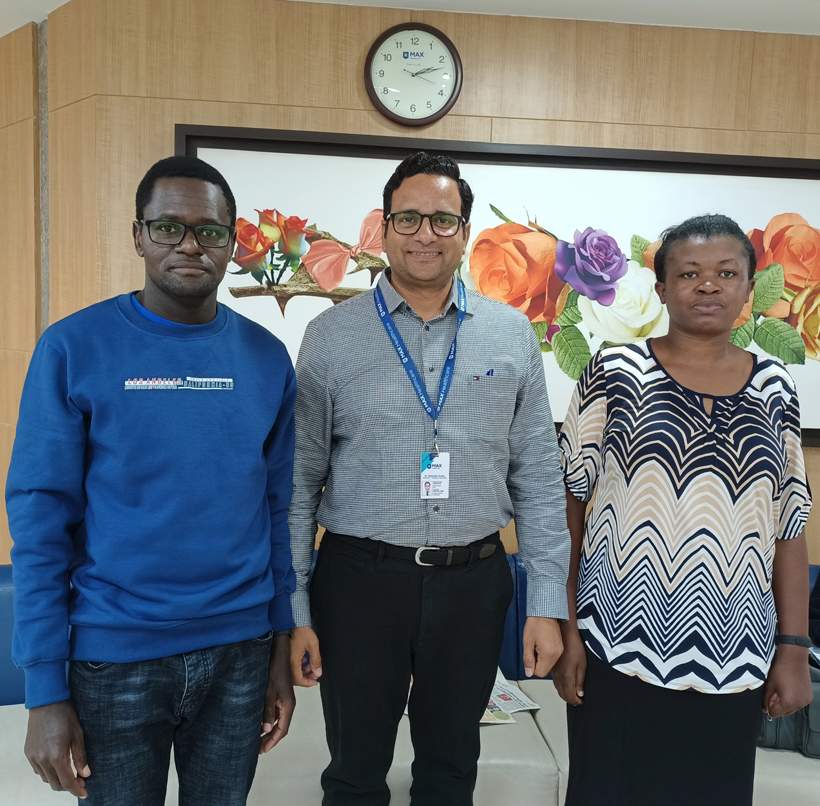
Kizito Namulanda (left), Dr. Rajendar Kumar (center), and Nancy Namulanda (right) at Max Hospital Shalimar Bagh, Delhi.
Part II: Treatment, Homecoming, and Hidden Struggles

By Kizito Namulanda

In the first part of this narration, I focused on the diagnosis decision to fly to India for treatment. In part two, I recount how treatment went and what unfolded after I returned home following completion of treatment.

Treatment Regimen
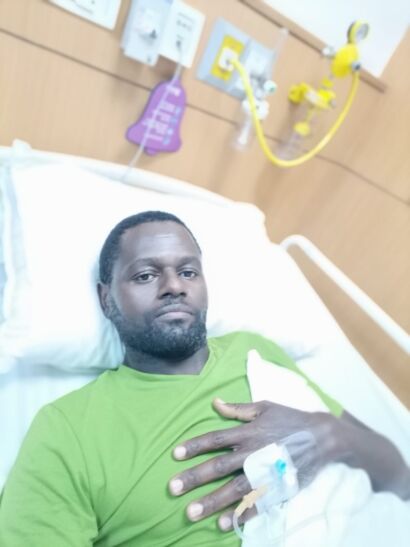
Kizito Namulanda in a green T-shirt lying in a hospital bed at Max Hospital during cancer treatment, with an IV line in his hand
Kizito Namulanda at Max Hospital during treatment

When I arrived in Delhi, the hospital—Max Super Specialty Hospital in Shalimar Bagh—had sent a driver to pick me up at Indira Gandhi International Airport. I was filled with anxiety. We wasted no time; the day after arriving, my coordinators Madam Shivangi and Mr. Vivek organised a consultation with the doctor. We first met Dr. Archit Pandit, who reviewed my case and referred me to the Head of Radiology, Dr. Rajendar Kumar. I remember Dr. Archit asking a question between me and my brother Peter Musumba, who was the patient. Physically, I looked perfectly fine. But when I spoke, he immediately said, “It must be you. I can tell from your voice.” I recall a caretaker at the hotel where I stayed making a similar joke as I left for the hospital that morning, saying I looked like a business executive going to hospital for business rather than a patient seeking treatment.

After further examination, which included repeating all the tests—including the biopsy and PET-CT scans—the doctors prescribed a combined radiotherapy and chemotherapy regimen administered concurrently. I underwent radiation sessions daily—Monday to Friday—with chemotherapy sessions running weekly. The radiation sessions were brief and easy, lasting about five minutes; you basically feel nothing, but as the days passed, I began losing weight and feeling weaker. The chemotherapy sessions were more challenging. The team of doctors who treated me—Dr. Rajendar Kumar, Dr. Ajay Shamar, Dr. Naman Utreja, and Dr. Jyoti Mehta—were very friendly and kind, always giving me hope and praising my fighting spirit.

Return, Recovery, and Recalibration

After rigorous treatment, I was cleared to travel back home to recuperate. Though I remained very weak, my doctors believed that being in a familiar, family-centered environment would speed up my recovery. I lost a total of 34 kilogrammes, dropping from 74 to 40. Radiotherapy had targeted my throat, turning feeding into a painful challenge. I could only manage small amounts of finely blended foods after taking medicines that numbed my throat to dull the pain. The pain grew worse with each passing day. I had to stay strong.
The doctors gave me a lot of hope, explaining that they had treated worse cases and were confident I would be healed completely. Those words gave me immense strength.

Three and a half months later, I was cleared to travel back home after completing treatment. When I landed at JKIA, my uncle waited as I was wheeled out by my brother Peter Musumba, whom I had travelled with as my caregiver. My uncle quickly examined me and took me to where my wife was waiting. He had asked my wife not to come to the airport but to wait for me at a shopping center near home, where he would drop me after picking me up at the airport.

Covid-19 Precautions and Quarantine

Tears rolled down my wife’s cheeks when she saw me. Communicating by phone hadn’t prepared her for how wasted I looked. Before I traveled back, the government had issued Covid-19 spike alerts, so we had to be careful. The doctors had warned that my immune system was still very weak and could not fight infections, so we had to take every precaution to avoid infections. Covid-19 and malaria were major concerns.

It was tough. I was not allowed to entertain visitors or mingle with my family. Once home, I was effectively quarantined in my room, with no one allowed to enter. The only time someone came in was to bring food and collect the dishes afterward. In most cases, the person who delivered the food would leave it by the door and depart. I did everything possible to avoid contracting any communicable diseases. The hardest part, however, was containing my young son, who could not understand what was happening.

I was instructed to do blood tests every two weeks and send them over to Max Hospital in New Delhi for close monitoring before travelling back for review after three months. The only time I left my room was to do those tests; no one, not even close family members, could visit. Some relatives and friends could not understand the restrictions.

Echoes from Home

After some time, pressure from my family back in the village grew. Everyone wanted to visit, and there was concern that we might be hiding something. After consulting with my uncle, we decided to visit home for two or three days before returning, to ease the concerns and logistics without risking my health. We thought it would be easier for me to travel than allowing relatives to come visiting to Nairobi.

The moment I arrived home and word spread, my compound filled up with visitors. After a session with my nuclear family, I had to entertain more guests. Managing the interactions was not easy. Tears streamed down my cheeks when I saw the reactions of close friends and relatives. It was very emotional.

One elder’s response has never left my mind. He arrived while I was resting, he was received and served food, I entered the room while he was eating. My voice was so weak that I needed an amplifier to be heard, so he didn’t hear me when I said hello to him.

Moments later, he turned to one of the servers and said, “You people, I appreciate that you’ve given me some food, but what really brought me here is to see Mheshimiwa (that’s how they call me in the village). Where is he? Although I am eating, I can’t say I’m enjoying this meal.” The room’s faces shifted between awkwardness and humor. Then one person asked, “And who is this looking at you?” It was at that moment when he realised I was actually there and he couldn’t recognise me. In shock, he stood, looked at me, and spoke in low tone in Kiswahili, “Mheshimiwa ni wewe?” (Mheshimiwa is that you?) I smiled and replied that it was me. Overcome with emotion, he simply washed his hands before leaving without saying any further words.

My village visit was very emotional, friends and relatives turned up to support me in prayer and words of encouragement. But controlling interactions was becoming a problem. When a friend who was running for the office of the Governor of Busia County heard that I had come home, he decided to come visit. The moment he arrived; word went round and within minutes the compound was full of people as it was just a few weeks to elections. It became another campaign rally! It was at that point when we realised that we were not going to manage the situation. We cut short the visit and travelled back to Nairobi the following morning.

Throughout the visit, I drew a lot of strength from a saying that was repeated to me by so many people, Kwalulukha Kulooma. It’s a Luhya saying that basically means it’s better for a tree to shed all its leaves in a dry season than to dry up, for when the rain comes, it will sprout back to life again. I am happy that today I am healed and strong enough to start all over again, a true testament to this popular saying.

In the third and final part, I will focus on recurrence, surgery, and the aftershocks that followed.

Covid-19 Precautions and Quarantine

Tears rolled down my wife’s cheeks when she saw me. Communicating by phone hadn’t prepared her for how wasted I looked. Before I traveled back, the government had issued Covid-19 spike alerts, so we had to be careful. The doctors had warned that my immune system was still very weak and could not fight infections, so we had to take every precaution to avoid infections. Covid-19 and malaria were major concerns.

It was tough. I was not allowed to entertain visitors or mingle with my family. Once home, I was effectively quarantined in my room, with no one allowed to enter. The only time someone came in was to bring food and collect the dishes afterward. In most cases, the person who delivered the food would leave it by the door and depart. I did everything possible to avoid contracting any communicable diseases. The hardest part, however, was containing my young son, who could not understand what was happening.

I was instructed to do blood tests every two weeks and send them over to Max Hospital for close monitoring before travelling back for review after three months. The only time I left my room was to do the tests; no one, not even close family members, could visit. Some relatives and friends could not understand the restrictions.

Echoes from Home

After some time, pressure from my family back in the village grew. Everyone wanted to visit, and there was concern that we might be hiding something. After consulting with my uncle, we decided to visit home for two or three days before returning, to ease the concerns and logistics without risking my health. We thought it would be easier for me to travel than allowing relatives to come visiting to Nairobi.

The moment I arrived home and word spread, my compound filled up with visitors. After a session with my nuclear family, I had to entertain more guests. Managing the interactions was not easy. Tears streamed down my cheeks when I saw the reactions of close friends and relatives. It was very emotional.

One elder’s response has never left my mind. He arrived while I was resting, he was received and served food, I entered the room while he was eating. My voice was so weak that I needed an amplifier to be heard, so he didn’t hear me when I said hello to him.

Moments later, he turned to one of the servers and said, “You people, I appreciate that you’ve given me some food, but what really brought me here is to see Mheshimiwa (that’s how they call me in the village). Where is he? Although I am eating, I can’t say I’m enjoying this meal.” The room’s faces shifted between awkwardness and humor. Then one person asked, “And who is this looking at you?” It was at that moment when he realized I was actually there and he couldn’t recognize me. In shock, he stood, looked at me, and spoke in low tone, “Mheshimiwa ni wewe?” (Mheshimiwa is that you?) I smiled and replied yes, Mzee, it’s me. Overcome with emotion, he simply washed his hands before leaving without saying any further words.

My village visit was incredibly emotional, friends and relatives turned up to support me in prayer and words of encouragement. But controlling interactions was becoming a problem. When my friend of mine who was gunning for the position of Governor of Busia had that I heard that I come home, he immediately came to visit. The moment he entered my compound, word went round and within minutes the compound was full of people as it was just a few weeks to elections. It became another campaign rally. It was at this point when we were not going to manage the situation. We cut short the visit and traveled back to Nairobi the following morning.

Throughout the visit, I drew a lot of strength from the words that were uttered by many of those who came to see me—Kwalulukha Kulooma. It’s a Luhya saying that basically means: it’s better for a tree to shed all its leaves in a dry season than to dry up, for when the rain comes, it will sprout back to life again. I am happy that today I am healed and strong enough to start over again.

In the first two parts of this narration, I focused on the diagnosis, the journey to India for treatment, and what unfolded after I returned home following completion of treatment. In the third and final part, I turn to recurrence, surgery, and the aftershocks that followed.
When someone confronts hardship and emerges stronger, we label them a Life Champion.
Editor
AUTHOR BIO

Kizito Namulanda is a seasoned Digital and Broadcast Media Executive renowned for leading digital newsroom transformations, digital innovation, and audience growth. A trusted editor and strategist, he has built enduring relationships with stakeholders and audiences, turning bold ideas into measurable results.

Today, Namulanda channels that same tenacity into a deeply personal three-part series that chronicles his battle with laryngeal cancer, the fight for voice, and the resilience required to rebuild life and career after recurrence. This narrative blends his professional rigor with lived experience, illustrating how courage, faith, and family sustain hope in the face of illness.

2 Comments

  • Jeff Usaaji
    Posted December 5, 2025 at 2:52 pm

    May the Almighty God grant healing to you, Kizito. You have been a fighter, a media warrior, a borderless and boundless friend to many. It shall be well, Bro.

  • irene mwania
    Posted December 12, 2025 at 2:52 pm

    May our good Lord give you total healing. Cancer is a monster.

Leave a Comment